
How Lake Ontario Helps Cool 151 Front Street West.
How does Deep Lake Water Cooling work?
The concept is relatively simple.
1. Cold water is drawn from Lake Ontario.
Intake pipes extend several kilometres into Lake Ontario, reaching depths where the water remains cold year round.
2. The water is brought into Toronto.
The lake water travels through the system to Enwave’s energy facilities, where its naturally cold temperature becomes the source of cooling for downtown buildings.
3. Heat exchangers transfer the cooling.
Rather than requiring every building to generate all of its own cooling mechanically, large heat exchangers transfer thermal energy between separate water loops.
The lake water itself does not simply circulate through individual buildings.
4. A network of water loops distributes the cooling.
One loop moves lake water, another distributes chilled water throughout downtown, and individual building loops connect to the system through heat exchangers.
This allows participating buildings to use the cooling capacity of Lake Ontario without relying entirely on conventional chillers and cooling towers.
5. The system saves both energy and water.
Traditional cooling towers can consume large quantities of water through evaporation. DLWC avoids much of that water loss.
Enwave estimates that the system saves approximately 220 million gallons (832 million litres) of water annually, equivalent to nearly 350 Olympic-sized swimming pools. The system also reduces peak electricity demand on Ontario’s grid.
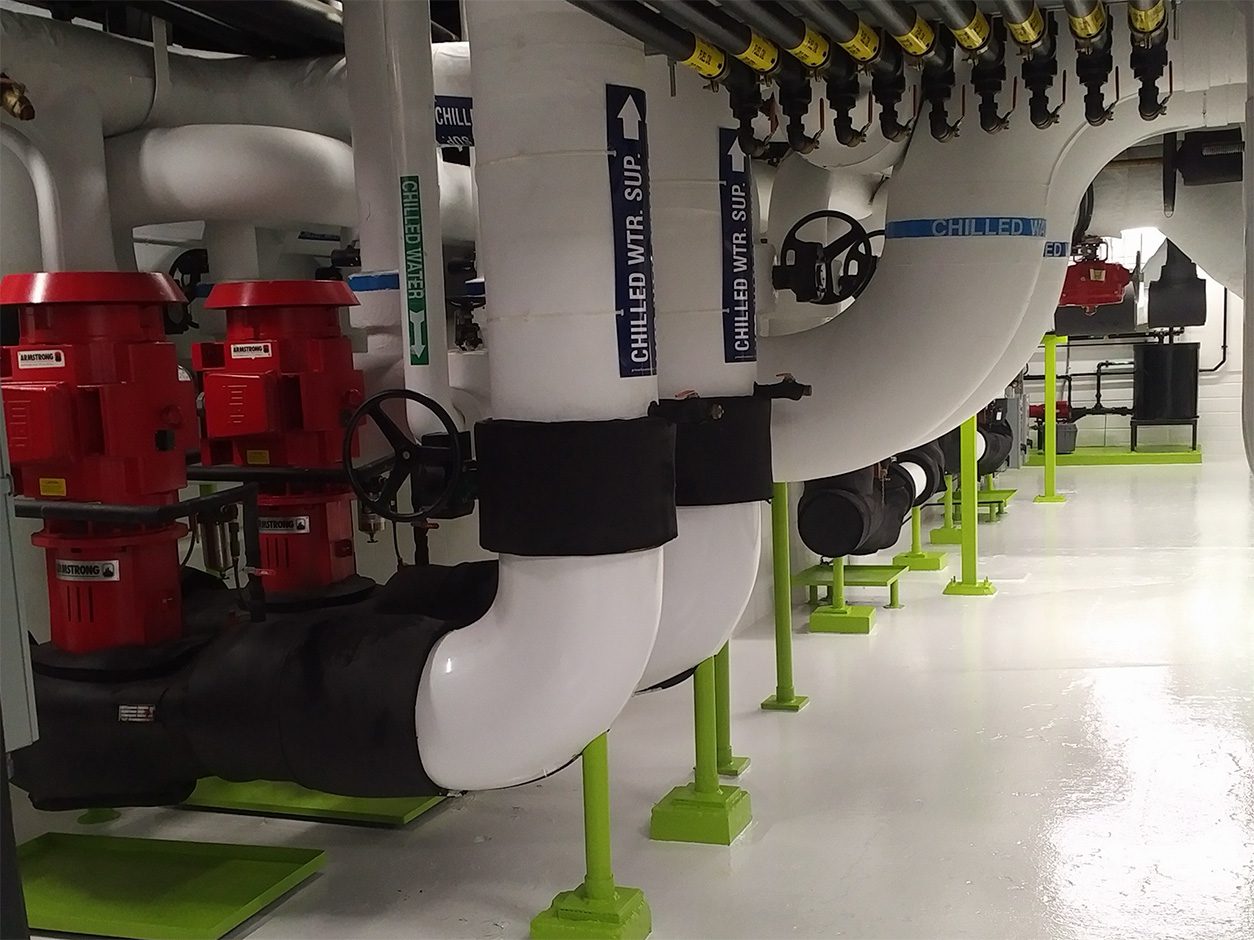
What does this mean for 151 Front Street West. and Coloware?
151 Front Street West. is the heart of Toronto’s telecommunications systems, where reliable power, connectivity, and cooling are all critical to keeping network infrastructure operating 24/7.
For Coloware, cooling is one piece of the larger infrastructure picture that’s mission critical for a carrier hotel.
Toronto’s Deep Lake Water Cooling system now serves more than 100 downtown buildings, including data centres, hospitals, commercial buildings, and other critical facilities. The system’s fourth intake, commissioned in 2024, increased its cooling capacity by 60% and expanded the potential to serve additional buildings.